The Abundance Summit made one thing clear: the timeline moved up.

Every March, I have the privilege of co-hosting the virtual experience for the Abundance Summit, Peter Diamandis' annual gathering of founders, CEOs, scientists, and investors near Los Angeles.
This was my fourth year working at the Summit in some capacity, and the energy felt significantly different than in the past. Singularity, Peter, and the Abundance Summit have a long history of talking about the future. This was the first time it felt like we weren’t discussing an impending future, but a very real present. At Singularity, we often focus on the convergence and speed of exponential technologies, but surrounded by these emerging deep tech startups and founders, I found myself coming back to the thought, “this is what exponential convergence actually feels like.”
This is my attempt at a breakdown of everything that was covered, and my take on what you should be paying attention to right now.
We're Not Preparing for the Future. We're Already In It.
Peter opened the summit with: "We're now demonetizing intelligence itself, turning watts into wisdom." The convergence of AI, robotics, energy, longevity, and digital infrastructure isn't approaching. It's here, and it’s all converging at once. Moving at what Peter called "hyper-exponential" speed, it’s reshaping how we raise our kids, run our companies, and govern our nations.
He made a point that your mindset is your greatest tool as a leader. Not a mindset you inherited from somewhere. The one you cultivate. That framing, shifting from operating from a place of fear or anxiety to one of agency should set the tone for how you operate.
AI Isn't Just Getting Smarter. It's Getting Hands.
Day 1 was dominated by the intelligence explosion in software. Ramez Naam walked us through how AI benchmarks are doubling every six or seven months. Paige Bailey from Google DeepMind introduced the phrase "yap to app" to describe how anyone can now talk an idea into a working application. And Eric Schmidt casually mentioned that he'd launched six coding jobs before taking the stage and expected them solved before he was done.
He said the work that would have taken him six months and ten programmers at Google can now be done by AI while someone sleeps. He urged every university to redesign its curriculum around AI literacy starting this September. Peter pushed back, “why not start in high school?” Schmidt laughed, but neither of them was joking.
I’ll be direct about vibe coding: it still leaves a bad taste in people’s mouths, especially those with technical experience. You can’t one-shot prompt an enterprise-ready app right now. But the raw capability of AI, and the pace of advancement, has shifted. Even technical people who’ve used Claude Code with the latest Opus models agree. Remember: right now is as bad as it’ll ever be, and improvement will only accelerate. Even Elon Musk, who joined the stage via Zoom, admitted he can’t keep up with the now-daily changes to models, tools, and infrastructure in AI.
Day 2 shifted focus from the digital to physical world. Peggy Johnson, CEO of Agility Robotics, described how Digit, their humanoid robot built specifically for warehouse work, has gone from pilot program to multi-fleet deployment in about six months, largely because AI made it dramatically faster to teach robots new skills. No more programming every step. Robots now learn from demonstrations.
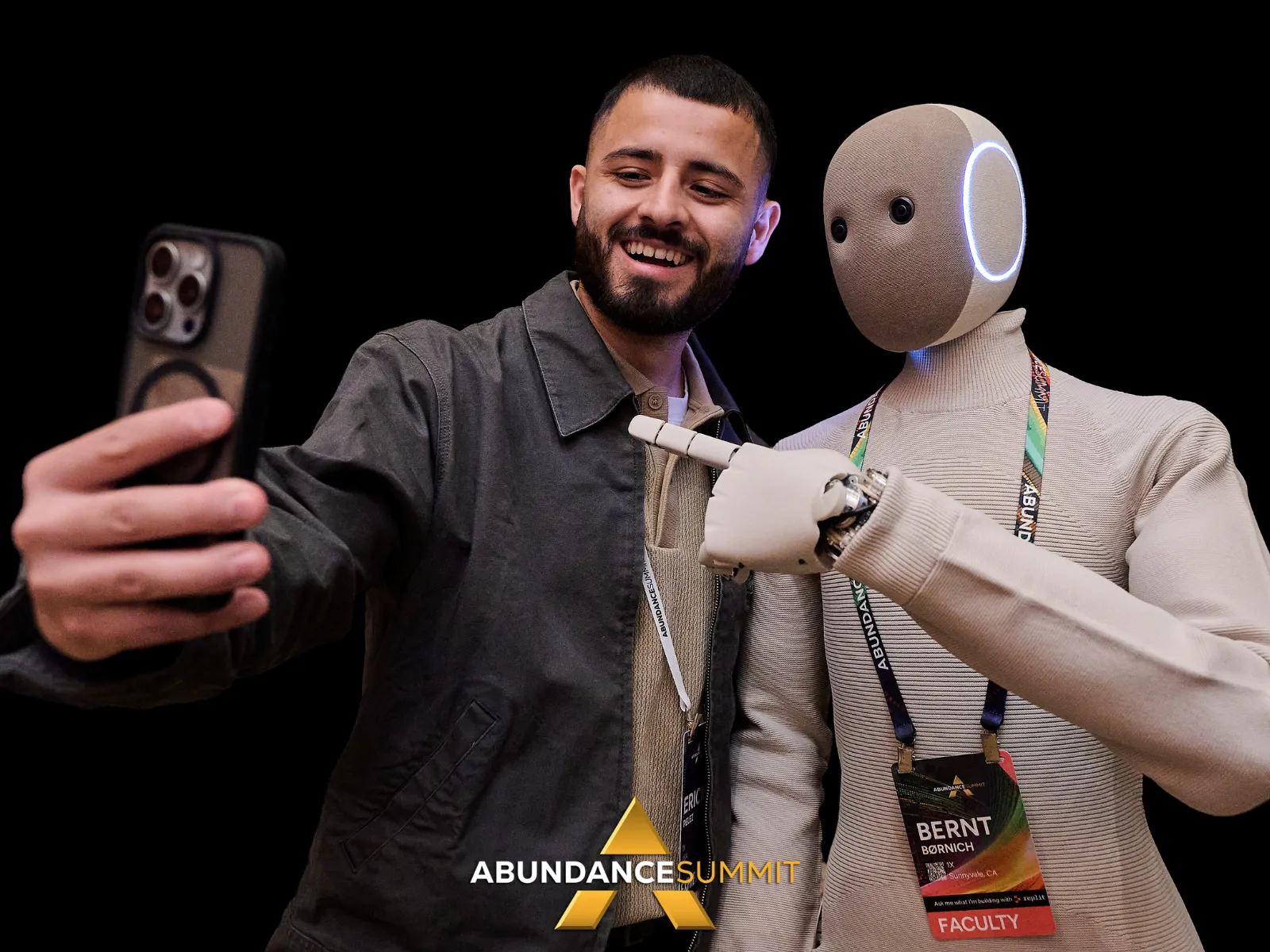
Seeing the Neo and Clone robots in person at the Summit stopped me. I’ve watched the videos of Tesla Optimus and Figure, and those blew my mind. But seeing a humanoid robot in real life, moving like a person, is a different experience entirely. Two years ago the robots were cool but still looked robotic, unsteady, and fragile. That is no longer the case. Their moment has arrived.
Peter had already set the stage for this with a compelling number: humanoid robots operating at under a dollar an hour by the mid-2030s, handling the dull, dangerous, and dirty work. At that price, as he put it, how many robots will you own? How many will you employ?
The robotics panel reinforced the message. This isn't about replacing people. It's about a hybrid world of human-robot collaboration, rolling out unevenly across industries, with the early movers learning fastest.
Two years ago I would have called that timeline aggressive. Having seen what I saw at the Summit, I now think it’s conservative. At Singularity we talk about how human brains aren’t wired for exponential growth. Check in on these technologies frequently to update your mental model. Don’t get caught off guard the way I did with the robots. It will only get faster from here.
Autonomous Everything
Dara Khosrowshahi, the CEO of Uber, was characteristically pragmatic about autonomous vehicles. He didn't paint a picture of a sudden binary flip (all-autonomous or nothing) but rather a gradual, hybrid transition. Uber's partnership with Waymo in Austin and Atlanta is already live. The interesting bit was Dara's framing of strategy: it's just as much about what you choose not to do as what you do. That discipline took Uber from losing four and a half billion a year to earning over ten billion. It's a lesson that applies to any company navigating the temptation to chase every shiny new technology.
Bob Mumgaard from Commonwealth Fusion Systems brought the energy piece into focus. Fusion, once a punchline about being "always 30 years away," is making real engineering progress. If fusion delivers on its promise of cheap, abundant, clean energy, it doesn't just change the power grid. It changes the economics of everything that runs on electricity, which increasingly means everything.
Be skeptical. And also imagine the most optimistic possible future. Both perspectives will serve you. Imagine a world of abundant energy, abundant labor, and abundant intelligence. What choices do you make if that’s real? Because it’s looking like it will be.
Biology Becomes a Programming Language
Day 3 was dedicated to longevity and the biological frontier, and it delivered some of the summit's most visceral moments.
David Sinclair shared that the first human epigenetic reprogramming trial is imminent. Patients are being recruited now. His lab's work on three of the Yamanaka genes, known as OSK, has shown age reversal in mice across brain tissue, muscles, kidneys, joints, skin, and more. They chose the eye for the first human trial. If it works, the liver is next.
Sinclair made a point that a true longevity therapeutic doesn't just work on one cell type. It works throughout the entire body. And that the cost could come down to a couple hundred dollars a month. This is medicine heading toward accessibility at scale.
There’s real debate in the scientific community about Sinclair’s research, and that’s healthy. At the same time, multiple players are working toward the same goal. My read: like fusion energy, this has a real chance of moving from science fiction to reality on a timeline we’re not prepared for.
Then Ben Lamm, CEO of Colossal Biosciences, took the stage and essentially described biology as the next programmable platform after software. Colossal's headline is de-extinction (woolly mammoths, Tasmanian tigers, the dodo) but that's the hook, not the whole story. What Peter highlighted is that Colossal is really building an AI-powered platform for designing living products. The same system that can build a mammoth can engineer microbes that break down plastic. And it's already spinning out companies to do exactly that.
When someone in the audience asked Lamm if he could make a Pikachu, he said "probably." It got a laugh, and it crystallized how far synthetic biology has come from the theoretical.
The Meta-Takeaway: Convergence Is the Story
If I had to compress three days into one sentence: the most important developments are happening at the intersections.
AI plus robotics equals autonomous physical labor. AI plus biology equals programmable life. AI plus energy equals the infrastructure to power it all. AI plus neuroscience equals a new interface between humans and machines. None of these are science projects anymore. They're companies with revenue, clinical trials with patients, and robots in warehouses.
At Singularity we talk about exponential technologies—domains of science and technology that get digitized, and therefore impacted by the exponential growth of computation. Once biology converges with AI, its pace of change accelerates because of AI’s acceleration. The same goes for any domain. Keep your eye on this phenomenon.
Peter said something toward the end of the summit that kept me thinking: "I am so excited about the intersection of advanced superintelligence, robotics, and longevity. There's a convergence in those three things. And it's gonna put us into warp speed."
He also quoted E.O. Wilson: "The real problem of humanity is we have Paleolithic emotions, medieval institutions, and god-like technologies."
That tension, between the speed of the technology and the pace of our institutions, was the undercurrent of the entire summit.
What I'm Taking Back to My Work
I left the summit thinking less about any individual technology and more about the question every leader needs to sit with: If intelligence (both digital and physical) is becoming abundant and cheap, what is your actual competitive advantage?
It's not expertise. That's being commoditized. It's not information. That's everywhere. The answer, I think, is in proprietary relationships, original data, speed of execution, and the courage to redesign systems rather than optimize old ones. Most importantly, it’s in being human.
The other thing I'm carrying with me is Peter's insistence on healthspan. He pushed every attendee to think of themselves as "the CEO of their own biology," tracking biometrics, investing in diagnostics, taking longevity seriously not as vanity but as strategy. If the productive lifespan is extending, as Sinclair's work suggests it might, that changes career planning, retirement models, investment horizons, and how we think about leadership development. And for a nerd like me, the longer I’m around, the more I’ll get to witness and participate in the most interesting moment (so far) in human history.
The Abundance Summit has always been about big thinking. This year, it was about big thinking that's arriving faster than anyone expected. Imagine a global economy that’s 10x bigger in 10 years (an Elon prediction). If that’s the case, what is humanity doing 10 years from now? Are 99% of our current problems solved? Are we a truly space-faring civilization? Do we enter the next phase of humanity? Based on what I saw, it’s possible. The primary challenge won’t be technology. It will be the quality of our choices. Our leadership is what will define what kind of future we can expect.