Featured Futuremakers: Four Alumni, Four Ways of Seeing

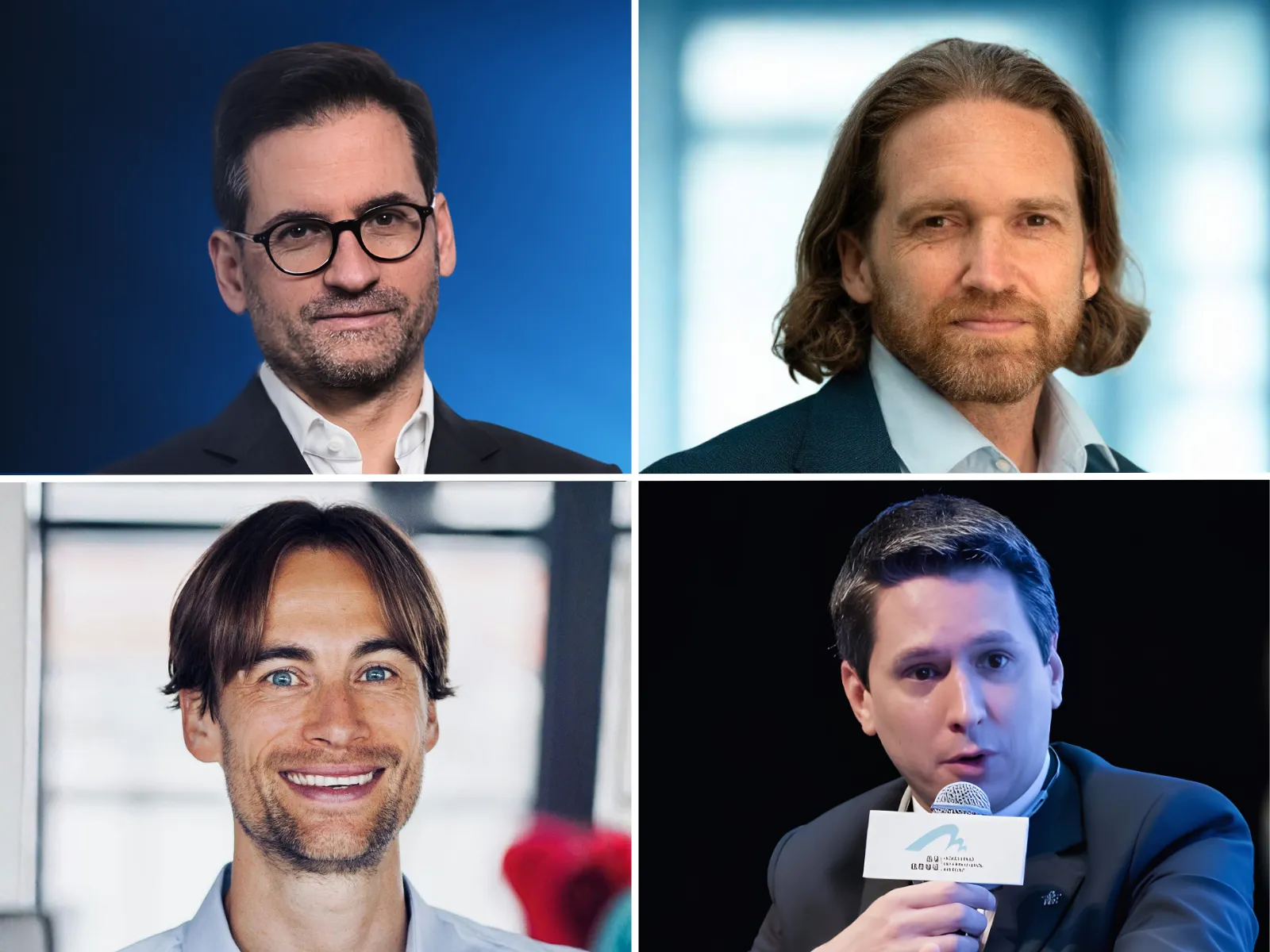
Featured Future Makers | Pedro Pinheiro (EP Nov ’24), Kai Rassmus Landwehr (EP Oct ’24), Nicolas Weber (EP Oct ’24), and Thomas Pellegrin (EP Apr ’24).
What Survives After the Week
The most interesting thing I'm noticing in recent alumni conversations isn't what's being built. It's what's no longer being tolerated. Not the new ideas, but the old assumptions that no longer survive contact with a clearer mind.
Over the past few months, a through line emerged across four conversations in four different time zones, all revealing the same shift: the Executive Program didn't give you a new direction. Rather, it raised your threshold. It sets a higher standard for how you think, decide, and act in the worlds you inhabit.
Pedro: The Cost of Compromise
I started with Pedro, who has spent more than twenty years inside venture capital and M&A, both as a partner at Oaklins and as a professor teaching the next generation of investors in Lisbon. Our conversation centered on understanding the ways in which the program reshaped his thinking. I asked him why someone who built a career on having the answers would choose to sit through another program. He did not pause:
"I wanted to reconnect with myself as a learner."
That line struck a chord with me because beneath the surface was a full reframing of identity. Pedro no longer treats duplication as the cost of doing business. He treats it as waste. Every workflow, document and habit is now an active question: Can this be cleaner, faster, smarter?
"Quality compounds," he told me. "So do small improvements. Once you see that, you can't unsee it."
His version of exponential is not bigger. It is better, repeated until there is nothing left to excuse.
Kai: The Coordination Problem
Then I spoke with Kai, who leads global marketing and climate strategy at myclimate. His career runs through carbon markets and a decade at Nike, underpinned by a master's degree in Ancient History that still shapes how he sees long arcs of change. He kicked off the conversation by making one thing very clear: climate work is not powered by hope.
"There is no — and there will be no — exponential technology that will solve climate change," he told me. "Pure technology alone will not solve the problem for us. It will contribute, it has to contribute, but it's not the single solution."
For Kai, the real leverage lives in the places where systems touch but fail to align. He is less interested in new innovations than in the "links and interfaces between these technologies and the people driving these technologies." His focus now is coordination, not invention. "If you make the right crosslinks, and bring together the right bunch of people, then you can really make a difference."
That is also why he keeps a tight circle of alumni in Zurich. They meet every two months, not for nostalgia, but to keep each other from drifting. "We meet regularly, have dinner together, and see how we can support each other with knowledge, ideas, connections." For him, staying sharp is a social act.
The past year has been professionally heavy: organizational restructuring, shifting climate politics, and "everything of [his]mental capacity" spent on internal transformation. But the conviction did not fade. The mindset did not soften. If anything, the constraints clarified the mission. Climate is a coordination problem, not a technology problem, and coordination is human.
Nicolas: The Ten-Year Question
Next was Nicolas joining from Berlin, a city he describes as a seasonal love story: "You fall in love with Berlin in summer and you fall out of love in winter." He has spent the past twenty-four years in healthcare, building and exiting companies across diagnostics, medtech, imaging, and software. After stepping back from the CEO role of his last company, he found himself in what he called a "soul-searching period," asking a single, precise question:
"What deserves my time for the next eight to ten years?"
He wasn't looking for a reinvention. He was looking for a filter. "I have built several companies," he said. "I manage investments, but I want to return to what I do best." In other words, to build again—to ideate from first principles, to create rather than merely steward.
What changed after the program was not his industry, but his horizon. He now talks less about ideas and more about time units. Not what can be built fast, but what is still worth building a decade from now.
That clarity led him into neurotech, specifically non-invasive brain-computer interfaces. He describes the space as "a fantastic rabbit hole," one with both scientific depth and commercial inevitability. He is still pre-company, assembling experts, but the conviction is already firm: "If you improve the brain, you can improve quite a lot in this world."
His philosophy of work mirrors his philosophy of running. He has completed multiple ultramarathons not to win, but to stay in the race long enough that winning becomes irrelevant. "I don't mistake speed for progress," he said. His actions say it more clearly than any quote: build patiently, compound effort, choose problems that can survive time, and then outlast them.
Thomas: The Exponential Reckoning
The final conversation was with Thomas late one evening from Singapore. He leads aviation strategy at Deloitte across Asia Pacific, with 25 years in consulting focused on operations and transformation in the most regulated industry on the planet.
He came to the Executive Program as a student of Ray Kurzweil. Having read his books in the 90s, Thomas understood exponential thinking intellectually and wanted to see it applied.
For Thomas, the shift didn’t come from new information. It came from gaining clarity about what’s actually at stake in his industry.
"I didn't leave with a new belief system," he told me. "I left with a clearer one."
Aviation is slow. It always has been. But the world around it isn’t waiting, and the exponential curve doesn’t negotiate. If the industry doesn’t adapt and reshape how it operates, it won’t just be disrupted; it will be replaced.
But here's what matters: Thomas isn't leaving aviation. He now approaches it differently—questioning processes, nudging strategies, helping leaders see what's possible in a system designed to move slowly. He's proving that change doesn't always mean leaving. Sometimes it means rethinking what's possible where you already are.
What They Stopped Accepting
Pedro stopped accepting wasted effort. Kai stopped accepting the belief that technology will save us. Nicolas stopped accepting urgency without endurance. Thomas stopped accepting the illusion that slow industries still have time.
The Executive Program didn’t change what they did. It changed what they refused to tolerate and raised the floor on their own thinking. They didn’t leave with new careers. They left with new standards and a clear understanding that clarity isn’t something you graduate from. It’s something you carry forward, compounding every time you refuse to settle.
The future does not reward adrenaline. It rewards clarity. And once you have it, clarity only grows.
Until next time… stay exponential.
.jpeg)
.jpg)